

Manchester City’s rise from a struggling Premier League club to one of the most dominant teams in world football has been one of the most remarkable sporting transformations of the modern era. Since the club’s takeover by Sheikh Mansour in 2008, Manchester City has enjoyed unprecedented success, winning multiple Premier League titles and becoming a global football powerhouse.
However, alongside this success, the club has faced one of the biggest financial controversies in football history. Allegations of financial rule breaches, sponsorship irregularities, and failures to cooperate with investigations have placed Manchester City at the center of a long-running dispute with football authorities.
The case, involving 115 alleged Premier League financial breaches, has raised questions about financial regulation, competitive fairness, and the future legacy of one of football’s most successful teams.
The Origins of the Manchester City Financial Controversy
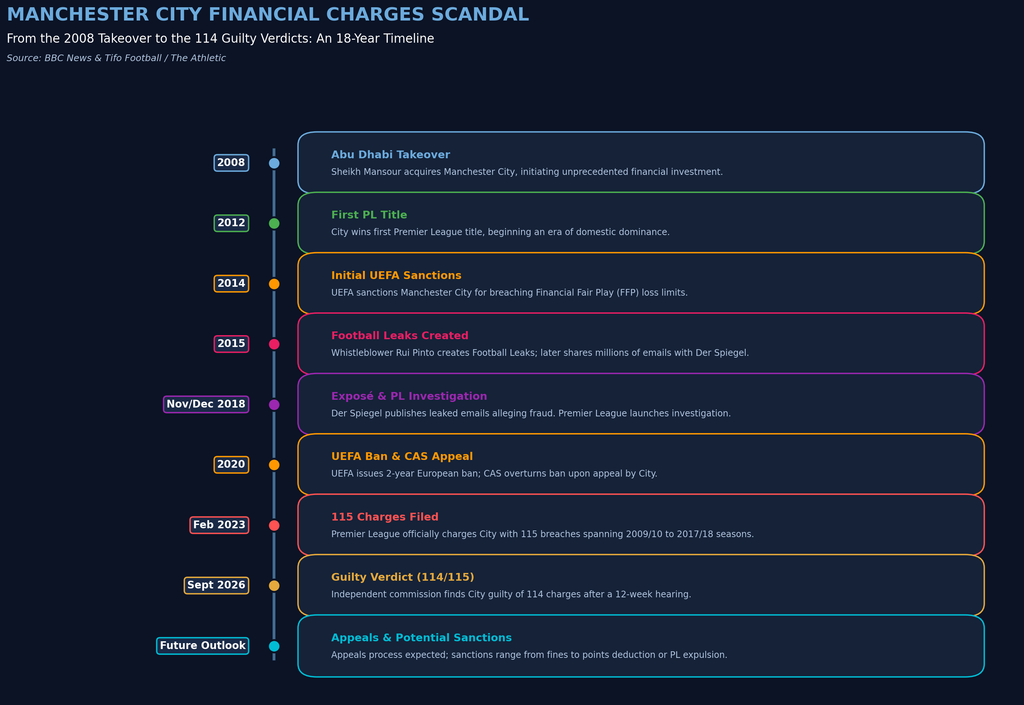
The story begins in 2008, when Manchester City was purchased by Sheikh Mansour, a member of Abu Dhabi’s ruling family. The takeover transformed the club’s financial position, allowing it to invest heavily in players, infrastructure, and global expansion.
Within a few years, Manchester City became a dominant force in English football. The club won its first Premier League title in 2012 and continued to collect major trophies under managers such as Roberto Mancini and Pep Guardiola.
However, concerns about the club’s financial activities emerged soon after the takeover. In 2014, UEFA sanctioned Manchester City for breaching Financial Fair Play (FFP) regulations, resulting in restrictions on spending and a financial penalty.
The controversy intensified in 2018 after documents obtained by Portuguese hacker Rui Pinto, the founder of Football Leaks, were shared with journalists from the German publication Der Spiegel. The leaked documents raised allegations that Manchester City had misrepresented financial information to comply with spending regulations.
According to the allegations, the club:
- Inflated sponsorship revenues by receiving funding connected to its Abu Dhabi ownership network while presenting it as independent commercial income.
- Failed to fully disclose certain financial payments, including alleged arrangements involving wages and image rights.
- Provided incomplete financial information to football authorities.
Manchester City has repeatedly denied these accusations, stating that the allegations are based on incomplete information and insisting that the club has always followed financial regulations.
The Premier League Charges: What Are the Allegations?
In February 2023, the Premier League announced that Manchester City had been charged with 115 alleged breaches of financial regulations covering the period from the 2009–10 season to the 2017–18 season.
The charges were divided into several major categories:
1. Inaccurate Financial Reporting
The largest group of allegations involves claims that Manchester City failed to provide accurate financial information, particularly regarding commercial revenue and sponsorship agreements.
The Premier League alleged that some sponsorship income connected to Abu Dhabi-linked companies was not accurately represented in financial reports.
2. Failure to Disclose Player and Manager Payments
Another set of charges relates to alleged failures to fully disclose employee payments.
One example involved former manager Roberto Mancini, with allegations that he received additional compensation through a separate Abu Dhabi-linked arrangement. Manchester City has disputed wrongdoing in relation to these claims.
3. Profit and Sustainability Rule Breaches
The Premier League’s Profit and Sustainability Rules are designed to prevent clubs from spending beyond sustainable limits.
The allegations suggest that Manchester City may have exceeded these limits by understating expenses and overstating revenue during the period under investigation.
4. UEFA Financial Fair Play Issues
Some charges relate to alleged breaches of UEFA’s Financial Fair Play regulations.
Previously, UEFA banned Manchester City from European competitions for two seasons in 2020 over alleged FFP violations. However, the ban was overturned by the Court of Arbitration for Sport (CAS) after an appeal.
5. Failure to Cooperate with the Premier League Investigation
The Premier League also accused Manchester City of failing to provide requested information during its investigation.
The club has argued that it was exercising its legal rights and maintaining confidentiality over certain documents.
Manchester City’s Response
Manchester City has consistently denied all allegations and maintains that it has complied with all financial regulations.
The club has stated that it welcomes the opportunity to present its evidence through the independent legal process and has expressed confidence in its position.
The period covered by the investigation coincided with one of the most successful eras in Manchester City’s history. During these seasons, the club won multiple trophies, including:
- Three Premier League titles
- One FA Cup
- Three League Cups
- One Community Shield
Timeline
What Could Happen Next?
The outcome of the case could have significant consequences for Manchester City and English football as a whole.
Possible Punishments
If the charges are upheld, the Premier League has several possible disciplinary options. These could include:
- Large financial penalties
- Points deductions
- Restrictions on future activity
- Possible expulsion from the Premier League
The final punishment would depend on the findings of the independent commission and the severity of any confirmed breaches.
Potential Appeals
Manchester City is expected to challenge any unfavorable decision through the legal process. Appeals could extend the timeline of the case for months or even years before a final resolution is reached.
Possible Legal Action from Rival Clubs
A confirmed breach could also lead to legal claims from rival clubs.
Teams that believe they suffered financial losses because of Manchester City’s alleged actions could potentially seek compensation for issues such as lost prize money, league positions, or European qualification opportunities.
The Impact on Manchester City’s Legacy
Beyond possible punishments, the case could influence how Manchester City’s achievements are viewed historically.
The club’s success over the past decade has been built on extraordinary investment, elite management, and world-class players. However, if financial violations are ultimately confirmed and penalties are imposed, questions could remain over how much of that success was achieved within the rules.
At the same time, Manchester City’s supporters argue that the club’s achievements are the result of strong sporting decisions, excellent coaching, and sustained investment in football operations.
Conclusion
The Manchester City financial charges case represents one of the most significant disputes in modern football. It combines issues of financial regulation, club ownership, sponsorship practices, and competitive balance.
While the legal process continues, the outcome could have lasting effects not only on Manchester City but also on how football authorities regulate powerful clubs in the future.
For now, the case remains unresolved, with the final decision expected to shape discussions about financial fairness and accountability in football for years to come.
Leave a Reply